
In Praise of the Wandering Mind
Reflections on Agnes Callard, Derek Thompson, and the “uni-context.”
There’s a conversation making the rounds between the writer Derek Thompson and the University of Chicago philosopher Agnes Callard, built around a term that Callard coined: the uni-context. Her idea is that we increasingly live inside one universal field of judgment, where “the ways you should act become the same across all different contexts.” What makes this strange is that for most of human history we moved between many contexts, or small worlds — home, work, the market, places of worship — each with its own rules and its own way of paying attention. But over time, and accelerated by technology, all of these have merged into a single, unified context. Screens didn’t invent that collapse, Callard argues, so much as answer a hunger for it: technology “caught on in large part because of this impulse people have to live in a uni-context.”
It’s a rich conversation, and a few threads in it kept pulling at us, because they touch some questions we mull constantly at Cicero.
Attention, and a quiet defense of daydreaming
One idea was Callard’s take on attention — something we all seem to be fretting about right now: not being able to focus, getting distracted, having it stolen from us. She has a helpful framing. Historically, “the norm for human beings,” she says, “is a bottom-up management of attention. You pay attention to what’s salient in your environment.” What’s new is a constant top-down effort: the feeling that we must consciously decide, moment to moment, where our minds are allowed to go.
We love her example. Think of the great 19th-century novels, she says, where a woman — and it’s always a woman: Emma Bovary, Anna Karenina — is reading, gets caught up in her own turbulent inner life, and sets the book down to daydream a moment. “But a thing that never happens is her saying to herself, ‘no, I need to get through another 20 pages.’” That kind of self-policing of focus simply wasn’t part of the furniture of the mind. We invented it.
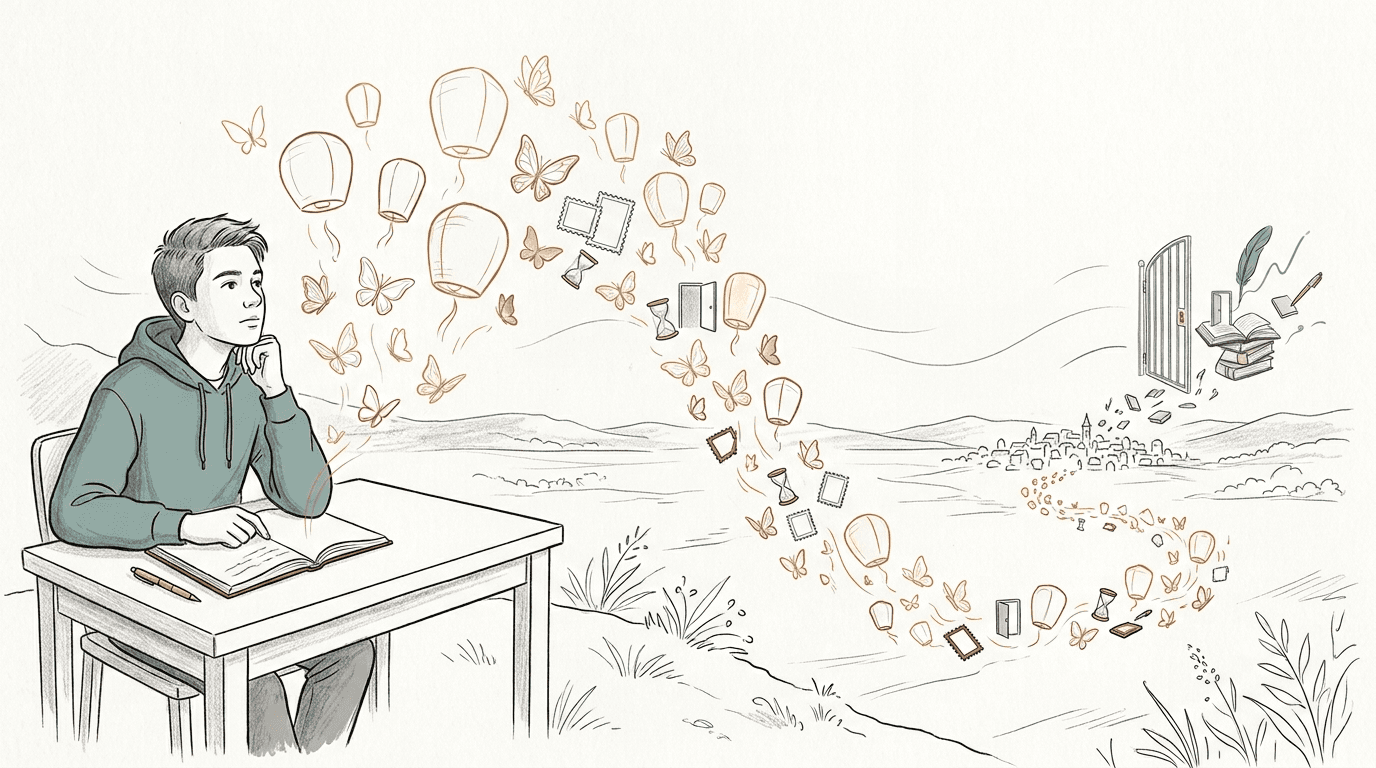
We find this clarifying, because at Cicero we spend a lot of time gently pushing back on the panic around distraction. When a child stares out the window, we’re taught to read it as a failure of focus. But we used to have a warmer word for it: daydreaming. And it turns out daydreaming isn’t the enemy of learning. It’s part of the engine.
Neuroscience is surprisingly firm on this. In a well-known 2012 study in Psychological Science, Benjamin Baird and Jonathan Schooler had people work on a creativity task, take a break, then return to it. The group that spent the break on an easy, undemanding activity came back markedly more creative than those who rested, kept grinding, or did something mentally taxing. Creative thinking, it turns out, is proportional to how much we let our minds wander.
Rest does something similar. In another 2012 study, Michaela Dewar and colleagues found that just ten quiet minutes after learning significantly strengthened what people remembered — both minutes later and a full week on. The brain uses those idle moments to consolidate and to file things away. A wandering mind isn’t an empty one; it’s a mind doing its housekeeping.
So when we tell parents and learners that some daydreaming is healthy, we mean it literally. Distraction is often just the mind being responsive: reaching sideways, making an unexpected connection, letting an idea settle.
The one-to-one relationship as a “local context”
A second thread. Callard’s worry about the uni-context is really a worry about the loss of small, particular worlds, and their replacement with one flat field where everything is compared to everything and, over time, homogenized. (She points to how analytics quietly made every baseball team play the same way.)
Education knows this pressure intimately. The drift toward one standard, one pace, one right answer for thirty different children is the uni-context arriving in the classroom. What one-to-one learning restores is exactly what Callard is mourning: a local context. A real relationship between one teacher and one learner is a small world with its own weather, its own jokes, its own trust, its own sense of what today’s lesson should be. We like to see 1:1 learning in the same light Callard uses for our old, rich world: a refusal to flatten.
World openness, and the freedom to choose what to love
Finally, Callard frames all of this as an expression of something deeply human: a resistance to “world closure,” a desire to choose our own values rather than inherit them. That, to us, is a beautiful description of what curiosity actually is. Learning at its best isn’t the transfer of a fixed inheritance from one head to another; it’s a learner discovering what they want to understand and being trusted to follow it. The best teachers we know aren’t gatekeepers of a closed world. They’re companions in an open one.
Callard is careful not to hand down a verdict on all this. “We are its products,” she says of the uni-context; “the first thing we need to do is get our bearings before we start judging.” We like that stance. The point isn’t to fear the noise of modern attention, or to romanticize some quieter past. It’s to notice how learning really works — in wandering, in relationships, in an open mindset — and to build around it on purpose.