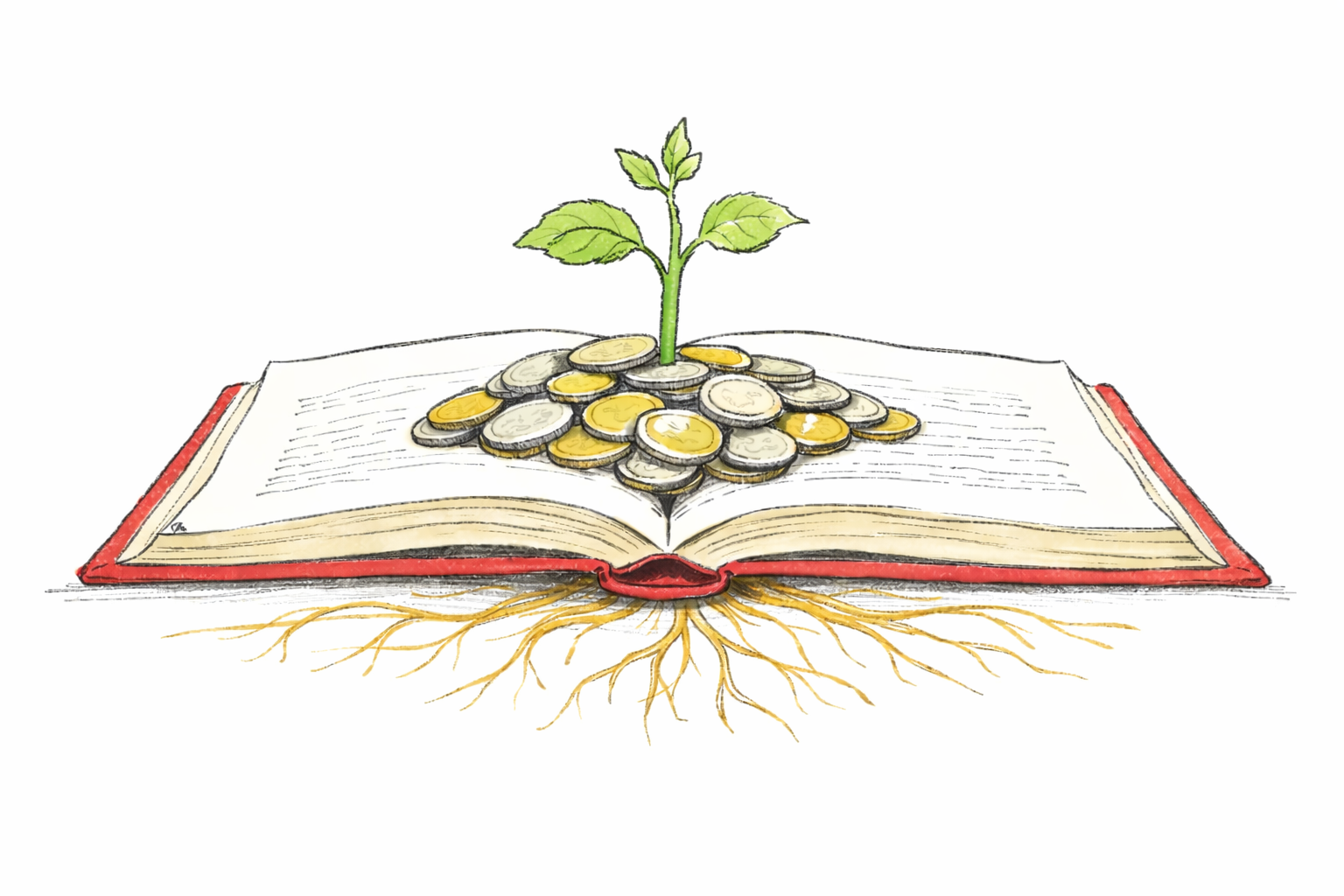
Money is part of your life long before you have a full-time job: saving for something you want, deciding whether a purchase is worth it, splitting costs with friends, or opening a first bank account. Financial Literacy 1—the first in a two-part, two-year course—gives you a clear, usable toolkit for making those choices that will assist in a lifelong relationship to money. Together we’ll learn how money works in everyday life—then practice using it in real scenarios, with numbers you can actually understand.
This course is designed to build calm confidence, not to heighten anxiety. You won’t just learn definitions and surface-level equations. You’ll learn how to make a plan, test it, and adjust it—because real financial decisions are rarely perfect on the first try.
What You’ll Learn
We’ll start with the basics that shape almost every financial decision: income, spending budget, saving, and tradeoffs over time. You’ll learn how to build a simple budget that matches real life (which is messier than most templates), and how to use a budget to make choices—not to feel restricted.
Along the way, we’ll connect personal finance to the big ideas underneath it: incentives, scarcity, and opportunity cost. That’s where economics shows up—not as a textbook subject, but as a way of understanding the world more clearly.
Budgeting That Actually Works
A budget is a plan for your money—one that helps you decide what matters most. You’ll learn how to track where money goes, categorize spending, and spot patterns that are easy to miss. We’ll talk about common budgeting approaches and choose one that fits your goal and your personality.
You might practice by building budgets for realistic situations: a monthly allowance, income from babysitting or a small business, or saving for a big purchase with a deadline. You’ll see how small choices add up—and how plans change when priorities change.
Topics often include:
- Needs vs. wants (and the many gray areas in between)
- Fixed costs vs. flexible costs
- Saving goals and timelines
- Tradeoffs: what you give up when you choose something
Saving With Purpose
Saving can be difficult, especially without a steady income. In this course, you’ll learn how to set savings goals that are specific and measurable—then build a realistic and flexible strategy for reaching them.
We’ll explore questions like: How much should you save if you don’t have something specific in mind? What if your income changes week to week? What’s the difference between saving for something fun and saving for something important—like your future?
You’ll also learn about emergency funds in a middle-school-appropriate way: what they are, why they matter, and how to start one even with small amounts.
Being a Smart Consumer
Advertising is increasingly sophisticated and harder to resist; your decision-making should be too. Together, we’ll build a practical method for evaluating purchases: price, quality, hidden costs, and alternatives. You’ll learn how to compare options and decide when spending money is actually the right choice.
We’ll also talk about value in a broader sense. Sometimes the “best” choice depends on what you care about—time, sustainability, comfort, status, generosity, or independence. Your job isn’t to spend as little as possible. It’s to spend in a way that matches your goals and values.
Real-world scenarios might include:
- “Is this worth buying, or will I regret it in a week?”
- “Should I buy the cheaper option now or the better one later?”
- “What costs don’t show up on the price tag?”
- “How do subscriptions and ‘free trials’ really work?”
Earning Money and Thinking Like a Planner
Middle school is a great time to explore how earning works—because it’s low-stakes, and you can experiment. We’ll look at different ways young people earn money and what each approach teaches: trading time for money, building a small service business, selling a product, or doing longer-term projects.
You’ll learn how to estimate income, plan around uncertainty, and avoid “money leaks” that quietly drain your progress. This is where numeracy becomes practical: you’ll do real calculations, not abstract word problems.
Interest and the Power of Time
At some point, every student hears the phrase “compound interest”—and it’s often presented like magic. We’ll make it concrete. You’ll learn what interest is, how it’s calculated, and why time matters as much as money.
You’ll see the difference between simple and compound interest, and how saving early can matter more than saving a lot later. (There’s a reason that Albert Einstein is often quoted as calling compound interest “the eighth wonder of the world.” Whether or not he said it, the idea behind the quote is absolutely true: compounding rewards patience.)
A First Look at Investing
Investing can sound intimidating, but the foundations are simple—especially when you learn them the right way. This course introduces the basic building blocks of investing in accessible terms: what stocks and bonds are, what it means to own part of a company, how risk works, and why diversification matters.
We’ll keep this grounded and age-appropriate: the goal isn’t to turn you into a day trader. It’s to help you understand the concepts that adults use every day—so you can make good decisions when the time comes. For a closer look at investing for high-school students, explore our Financial Literacy 2 course.
You may explore:
- Stocks, bonds, and funds (what they represent and why they exist)
- Risk and reward (and why “safe” and “risky” aren’t always obvious)
- Why people invest—and what investing is not
- How inflation affects saving over time
Banks, Accounts, and How Money Moves
You’ll also learn the basics of banking: what a bank account is, how deposits and withdrawals work, and what to look for when opening an account. We’ll demystify terms like balance, fees, and interest, and talk about the difference between checking and savings.
We’ll treat banking like a life skill: you should know what you’re agreeing to, what questions to ask, and what details matter.
Credit Cards: Useful Tool, Real Risk
Credit is one of the most important—and most misunderstood—parts of modern finance. We’ll explain how credit cards work, how interest and minimum payments can trap people, and why “buy now, pay later” can be more expensive than it looks.
You’ll learn how to read a basic credit card statement, what happens if you carry a balance, and how to spot the common pitfalls. The goal here is not fear—it’s clarity.
Who This Course is For
Financial Literacy 1: Foundations is ideal for middle school students (roughly ages 11–14) who want real-world skills and a practical relationship with money. It’s a strong fit for students who like clear systems, real examples, and learning they can use immediately.
You don’t need any prior background in economics or finance. You should be ready to do basic arithmetic and work with simple percentages; we’ll build the rest together.
This course can work especially well for:
- Students who are starting to earn money (allowance, chores, babysitting, small jobs)
- Students saving for a specific goal
- Students who want to feel more independent and capable
- Families who want money conversations to be calmer and more thoughtful
How the Course Can Flex
Depending on your age, experience, and goals, the focus of the course may shift. You might spend more time on budgeting and spending decisions, or go deeper into investing basics and long-term planning. If you already have a savings goal, we can build the course around it; if you don’t, we’ll help you choose one that feels meaningful.
Examples, case studies, and projects can also be tailored to your interests—sports, travel, tech, art supplies, a summer program, or a first big purchase—so the math stays connected to real motivation.
Course Project: a Personal Financial Plan
Your final project is to build a personal financial plan for a specific goal. You might choose something like saving for a car, funding a summer program, building an emergency fund, or reaching a savings target by a certain date. You’ll map out a strategy and show your reasoning: how you’ll earn, save, and—if appropriate—begin to invest.
Your plan will include:
- A clear goal with a timeline
- A simple budget that supports the goal
- A savings strategy (and how you’ll stay on track)
- A decision framework for spending along the way
- A short reflection on tradeoffs and priorities
What You’ll Take With You
By the end of Financial Literacy 1: Foundations, you should be able to make everyday money decisions with more clarity and less guesswork. You’ll understand the basics of budgeting, saving, banking, interest, and investing—and you’ll know how to apply them to your own life.
Most importantly, you’ll have a plan you built yourself. That’s the point: financial literacy isn’t about memorizing terms. It’s about learning to make choices—smart ones, repeated over time—that add up to real freedom.